RecordFlow
RecordFlow automatically saves Zoom cloud recordings to Google Drive and can delete them from Zoom to free up storage.
Visit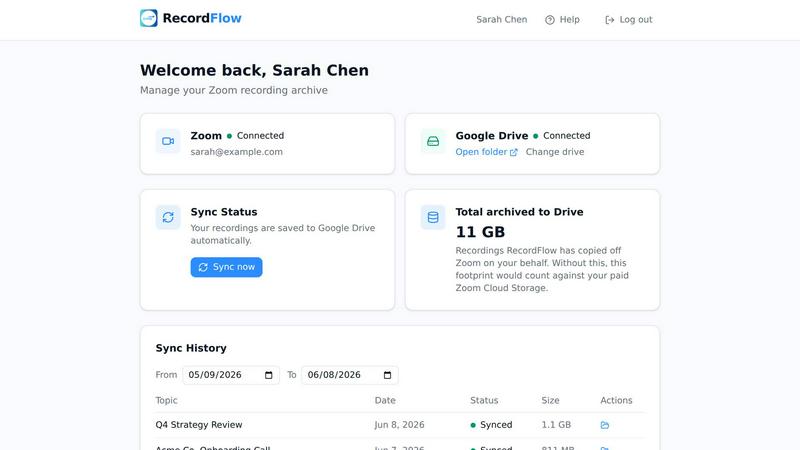
About RecordFlow
RecordFlow is a specialized automation tool designed to eliminate the tedious, manual process of downloading, organizing, and storing Zoom cloud recordings. The product automatically archives every Zoom cloud recording directly to a user's Google Drive the moment a meeting ends, and it can also backfill recordings from the past two years. This ensures that no recording is ever lost, forgotten, or left vulnerable to deletion. The primary value proposition is simple: stop paying for unnecessary Zoom storage and stop wasting hours on manual file management. Setup is remarkably fast, taking approximately 60 seconds. Users simply sign in with their Zoom account, connect their Google Drive, and select a destination folder. From that point forward, new recordings sync within minutes automatically and perpetually. RecordFlow is built for a specific audience: coaches, consultants, therapists, professors, small teams, and IT administrators who rely on Zoom recordings as critical assets. These users cannot afford to lose a single recording due to storage limits, accidental deletion, or retention policies. The tool handles every file type Zoom produces, including video (MP4), audio (M4A), transcripts (VTT and a formatted Google Doc), and chat logs. Files are organized neatly by year and date within the chosen Drive folder. An optional auto-delete feature safely removes recordings from Zoom on a configurable delay once the Drive copy is verified, freeing up valuable storage space. RecordFlow is designed for reliability, employing chunked transfers for large files, smart deduplication to prevent duplicates, and automatic retries for failed transfers. Critically, recordings stream directly to the user's Google Drive and are never stored on RecordFlow's servers, ensuring data privacy and security through OAuth 2.0 and AES-256 encryption.
Features of RecordFlow
Automatic and Continuous Synchronization
RecordFlow eliminates the need for manual downloads and uploads. The moment a Zoom cloud recording finishes processing, the tool automatically initiates a transfer to the user's designated Google Drive folder. This process is continuous and requires no user intervention. For new users, the service also offers a one-time backfill, archiving any recordings stored in Zoom from the past two years. This feature ensures that users have a complete and up-to-date archive in their Google Drive from day one, providing immediate peace of mind and a single source of truth for all recorded content.
Comprehensive File Archiving with Organization
RecordFlow does not just move the video file. It captures every asset associated with a Zoom cloud recording, including the MP4 video, M4A audio file, VTT transcript, and the chat log. Furthermore, it intelligently converts the VTT transcript into a formatted Google Doc, making it searchable and editable within the Google Workspace ecosystem. All files are automatically organized into a clear folder structure by year and date within the user's chosen Google Drive destination. This systematic organization eliminates the chaos of scattered files and makes finding specific recordings from past meetings straightforward and efficient.
Safe and Automated Zoom Storage Management
A key feature for managing Zoom storage costs is the optional auto-delete function. Users can enable RecordFlow to automatically delete the original recording from Zoom's cloud after a safe, configurable delay. The system only triggers this deletion after it has successfully verified that a complete and uncorrupted copy exists in the user's Google Drive. This ensures that users never lose access to a recording while simultaneously freeing up their limited Zoom storage (e.g., the 5 GB limit on Zoom Pro plans). This automated cycle prevents meetings from being blocked due to a full Zoom storage quota.
Reliable Architecture for Large and Critical Files
RecordFlow is engineered for dependability, especially for users who record long meetings or webinars. The system uses chunked file transfers, which break large video files into smaller pieces for upload. This prevents timeouts and failures that often plague standard upload methods. If a transfer is interrupted, the tool automatically retries from the point of failure, not from the beginning. Additionally, smart deduplication ensures that if a recording is already safely stored in Drive, running the sync again will not create a duplicate. This robust architecture provides a safety net that gives users confidence their critical data is being handled securely.
Use Cases of RecordFlow
Coaches and Consultants Archiving Client Sessions
Coaches, therapists, and consultants often record multiple client sessions each week. These recordings are not just for personal review; they are often a deliverable promised to the client. With Zoom's limited storage, professionals in this field can run out of space in days. RecordFlow provides an automated solution that sends each session recording directly to a Google Drive folder, which can then be easily shared with the client. This saves hours of manual work each week and ensures that every client session is securely archived and accessible for future reference, without the risk of accidental deletion from Zoom.
Educational Institutions Managing Lecture Archives
Professors and university IT departments need a permanent, accessible home for lecture recordings. Relying solely on Zoom's cloud storage is risky due to retention policies and storage caps. RecordFlow allows educators to automatically transfer all lecture recordings to a shared Google Drive, giving students lasting access to course materials. IT administrators can install the tool for the entire Zoom account, ensuring that all faculty recordings are centrally archived. This creates a valuable institutional knowledge base and ensures that students can review lectures long after the semester ends, without burdening the professor with manual file management.
Business Teams Streamlining Internal and External Communications
Business teams that record client calls, product demos, and internal strategy meetings can use RecordFlow to maintain a single, organized repository in Google Drive. This eliminates the need for team members to manually download and share files. When a recording is ready, an email notification with a direct link is sent, allowing for immediate sharing. This streamlines workflows, ensures that all team members have access to important information, and provides a centralized backup that is independent of the Zoom platform. It is particularly useful for sales teams who need to archive and analyze client interactions.
IT and Operations Admins Managing Enterprise Compliance
For IT and Ops Admins, managing an entire Zoom account's recordings can be a nightmare. RecordFlow provides an admin-level install option. Once installed and configured with a single root Google Drive folder, the admin can opt in specific members or teams. Every selected member's recordings are then automatically archived into their own sub-folder within the master Drive. This provides a centralized, auditable archive of all corporate communications. This use case is critical for compliance, data retention policies, and ensuring that no critical business communication is lost, even if a team member accidentally deletes a recording from their Zoom account.
Frequently Asked Questions
How long does it take for a recording to appear in my Google Drive?
RecordFlow is designed for speed and reliability. New Zoom cloud recordings typically appear in your designated Google Drive folder within minutes of the meeting ending. The system continuously monitors your Zoom account for new recordings and initiates the transfer process as soon as one is detected. For initial setup, the backfill of recordings from the past two years may take a bit longer, depending on the total volume of data, but the process is fully automated and runs in the background.
Is my data secure when using RecordFlow?
Yes, security is a core design principle. RecordFlow uses OAuth 2.0 for authentication, meaning it never sees or stores your Zoom or Google passwords. All data is encrypted in transit using TLS and at rest using AES-256 encryption. Crucially, recordings are streamed directly from Zoom to your Google Drive; RecordFlow's servers never store your video, audio, or transcript files. The tool also holds a minimal set of permissions, only accessing the specific files and folders it needs to create and manage your archive.
Can I use RecordFlow to archive recordings for my entire team?
Yes, absolutely. RecordFlow supports an admin installation mode. A Zoom account admin can install the tool for the entire account. During setup, the admin chooses a single root Google Drive folder as the archive destination. Then, the admin can select which members of the Zoom account to include. When recordings are made by these opted-in members, they are automatically placed into their own sub-folders within the master Drive folder, keeping everything organized and centralized for the admin.
What happens if a recording fails to transfer?
RecordFlow is built with a robust reliability architecture. If a transfer fails for any reason, such as a temporary network interruption, the system will automatically retry the transfer. It uses chunked uploads, so if a large file fails, it will resume from where it left off rather than starting over. The system also includes an hourly safety net to catch any recordings that may have been missed. If a transfer continues to fail, users will receive an email notification to alert them of the issue.
Explore more in this category:
Similar to RecordFlow
VideoToScript
Turn TikTok, Reels, Shorts, Facebook videos, audio, and video into accurate timestamped transcripts with TXT, SRT, and VTT exports.
Screen Beaver
Create product videos manually or let your AI agent control Screen Beaver through MCP—no mouse or keyboard needed.
TchoAI
Turn documents, notes, and data into clear, editable presentations in minutes.
Wisegrid
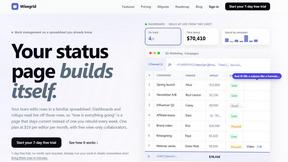
Wisegrid helps project-driven teams manage projects, workflows, resources, and reporting in a familiar spreadsheet-style workspace.