
TDEE Calculator
Accurately estimate your daily calorie needs using the proven Mifflin-St Jeor equation to achieve your weight and fitness goals.
Visit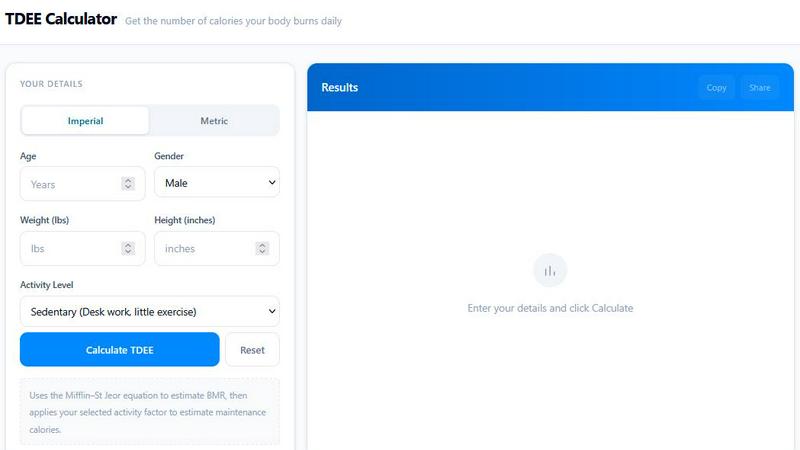
About TDEE Calculator
TDEE Calculator is a fast, accurate, and completely free online tool designed to help you estimate your Total Daily Energy Expenditure (TDEE) and plan your daily calorie intake with confidence. Whether your goal is weight loss, muscle gain, or maintaining your current physique, this calculator provides a reliable starting point based on proven physiological science. The tool is built for anyone looking to take the guesswork out of nutrition planning, from fitness beginners to experienced athletes and health-conscious individuals. By entering your age, sex, height, weight, and activity level, you receive an instant calculation of your maintenance calories, along with practical targets for creating a calorie deficit or surplus. The calculator employs the widely respected Mifflin-St Jeor equation, which research published in the American Journal of Clinical Nutrition has shown to be one of the most accurate methods for estimating resting metabolic rate in healthy adults. Beyond just a single number, TDEE Calculator delivers helpful insights including calorie deficit and surplus recommendations, macro guidance, and activity-based adjustments. This allows you to create a personalized nutrition plan that fits your lifestyle and specific goals. The tool is designed for speed, clarity, and practical use, presenting results in an easy-to-understand format that you can refine over time using real-world results. With a clean interface and no registration required, TDEE Calculator empowers you to make informed decisions about your energy balance, meal planning, and overall health.
Features of TDEE Calculator
Accurate Mifflin-St Jeor Equation
The calculator uses the Mifflin-St Jeor equation, a clinically validated formula that estimates Basal Metabolic Rate (BMR) based on your weight, height, age, and sex. For men, the formula is BMR = (10 x weight in kg) + (6.25 x height in cm) - (5 x age) + 5. For women, it is BMR = (10 x weight in kg) + (6.25 x height in cm) - (5 x age) - 161. This provides a highly reliable baseline for calculating your total daily energy needs.
Customizable Activity Level Selection
To accurately estimate your TDEE, the tool applies an activity factor to your BMR based on your typical daily movement and exercise habits. You can choose from five distinct levels ranging from Sedentary (1.2) for desk workers with little exercise to Athlete (1.9) for those with multiple daily training sessions. This ensures your calorie estimate reflects your actual lifestyle.
Instant Calorie Deficit and Surplus Recommendations
Beyond your maintenance calories, the calculator provides immediate, practical targets for fat loss and muscle gain. For weight loss, it suggests a daily deficit of roughly 250 to 500 calories, which typically supports steady fat loss without compromising energy levels. For muscle building, it recommends a daily surplus of about 200 to 350 calories to support progress without excessive fat gain.
Imperial and Metric Unit Support
The tool accommodates users worldwide by offering both Imperial and Metric measurement systems. You can easily switch between pounds and inches or kilograms and centimeters with a single click. This flexibility ensures that anyone, regardless of their preferred measurement system, can quickly and accurately input their details without needing to convert units manually.
Use Cases of TDEE Calculator
Weight Loss Planning
For individuals aiming to lose body fat, the TDEE Calculator provides a clear and actionable starting point. By determining your maintenance calories, you can establish a moderate calorie deficit that promotes steady fat loss while preserving muscle mass. The tool's deficit recommendations help you avoid overly restrictive diets that can slow metabolism and harm recovery. You can use the calculated target to plan balanced meals and track your progress over several weeks, adjusting your intake by 100 to 200 calories based on real-world results.
Muscle Building and Bulking
For those focused on gaining muscle mass, knowing your exact energy needs is crucial for effective bulking. The calculator provides a recommended calorie surplus that supports muscle protein synthesis and recovery without leading to excessive fat gain. Athletes and strength trainers can use this data to design a nutrition plan that aligns with their training volume. By monitoring weight changes over two to three weeks, users can fine-tune their surplus to optimize lean mass gains while minimizing unwanted body fat accumulation.
Maintenance and Body Composition Management
Many individuals want to maintain their current weight while improving body composition. The TDEE Calculator helps you identify your exact maintenance calories, allowing you to eat enough to sustain your energy levels and performance without unintentional weight gain or loss. This is particularly useful for athletes during off-seasons or for anyone who has reached their goal weight. The tool's macro guidance also helps you distribute your maintenance calories into appropriate protein, carbohydrate, and fat targets to support training and recovery.
Performance Optimization for Athletes
Competitive athletes and highly active individuals can use the TDEE Calculator to ensure they are fueling their bodies adequately for peak performance. Eating well below your TDEE for extended periods can negatively impact recovery, hormone balance, and training quality. By using the Athlete activity factor (1.9), the tool provides an accurate estimate for those with demanding training schedules. This allows athletes to strategically plan their calorie intake around training sessions, competition days, and rest days to maximize energy availability and performance outcomes.
Frequently Asked Questions
What does TDEE mean?
TDEE stands for Total Daily Energy Expenditure. It is the total number of calories your body burns in a single day. This includes your Basal Metabolic Rate (BMR), which is the energy required to keep you alive at rest, the thermic effect of food (energy used to digest and process food), and the calories burned through all physical activity and exercise. Understanding your TDEE is fundamental for managing your weight, as it represents the calorie intake needed to maintain your current weight.
How is TDEE different from BMR?
BMR, or Basal Metabolic Rate, is the number of calories your body needs to perform basic life-sustaining functions like breathing, circulation, and cell production while at complete rest. TDEE is a broader measure that includes your BMR plus all additional energy expended through daily activities, exercise, and digestion. In simple terms, BMR is the baseline, while TDEE is your total daily energy burn. The TDEE Calculator first estimates your BMR using the Mifflin-St Jeor equation and then multiplies it by an activity factor to calculate your TDEE.
How accurate is this calculator?
The TDEE Calculator uses the Mifflin-St Jeor equation, which research has shown to be one of the most accurate formulas for estimating resting metabolic rate in healthy adults. However, it is important to treat the result as a starting estimate rather than a perfect, fixed number. Individual metabolism can vary due to factors like genetics, muscle mass, and hormonal differences. For best results, use the calculated TDEE consistently for two to three weeks while monitoring your body weight. If your weight remains stable, the estimate is likely close. If you are gaining or losing weight unintentionally, adjust your intake by about 100 to 200 calories and reassess.
Should I recalculate after losing weight?
Yes, you should recalculate your TDEE after significant weight loss, typically after losing 10 pounds or more. As you lose weight, your body requires fewer calories to maintain its new, lower mass. Your BMR decreases because there is less body tissue to sustain. Continuing to eat the same number of calories that supported weight loss at a higher weight may slow your progress or lead to a plateau. Recalculating ensures your calorie targets remain accurate and effective for your current weight and goals.
Similar to TDEE Calculator


Holly AI
Holly AI automates patient scheduling and front desk tasks to help clinics grow without burnout.

Droidal Insurance Verification AI Agent
Droidal Insurance Verification AI Agent ensures real-time coverage validation, reducing denials and accelerating patient onboarding with 98% accuracy.