Ember
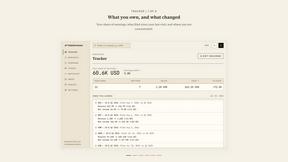
Ember delivers daily AI market calls with public scores and locked timestamps, flagging high-conviction signals when Ember diverges from the crowd by.
Visit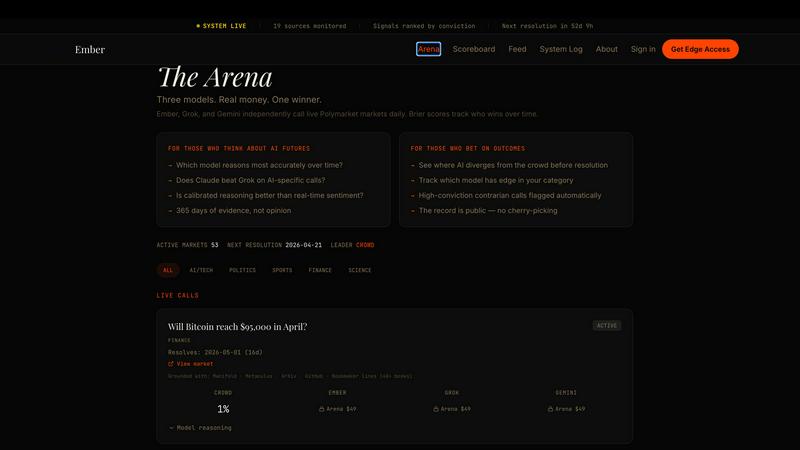
About Ember
Ember is a public AI prediction engine built on a premise of radical transparency: an AI that refuses to show its work is not worth trusting. Every morning at 7:00 AM EST, three genuinely independent AI models, Claude by Anthropic, Grok by xAI, and Gemini by Google, independently call live Polymarket markets before they resolve. They do not consult each other. When any model's probability diverges from the real-money crowd by 10 or more points, that divergence is flagged as a high-conviction signal. Every call is timestamped before the outcome is known, and accuracy is tracked using Brier scores, a calibration metric that rewards both accuracy and confidence. Nothing is edited after the fact. Every wrong call receives a post-mortem analysis. The record builds in public over a 365-day competition. Ember is designed for serious bettors, market analysts, AI researchers, and anyone who wants to see which AI model can consistently outperform the collective wisdom of prediction markets. By synthesizing data from 20 sources including Polymarket, Manifold, Metaculus, sports odds from 40+ bookmakers, AI research feeds from arXiv and Hugging Face, emerging tools from Product Hunt and GitHub, and real-time sentiment from X, Ember provides a unique window into where machine intelligence diverges from human consensus. The product operates on a simple principle: when three different AI models disagree with each other or with the crowd, that disagreement is where the edge lives. Subscribers receive signals at 7:00 AM EST before public release, giving them a timing advantage on high-conviction calls.
Features of Ember
Three Independent AI Models
Every morning, Claude, Grok, and Gemini independently analyze the same data and assign probabilities to live Polymarket markets. Claude reasons carefully from first principles, synthesizing prediction markets, bookmaker lines, and AI research feeds. Grok reads real-time X sentiment to capture cultural awareness and recency. Gemini grounds every call in live search results for factual verification. They do not consult each other, forcing genuine disagreement that becomes the signal.
Divergence Flagging System
When an AI model's probability diverges from the Polymarket real-money crowd by 10 or more points, that divergence is automatically flagged as a high-conviction signal. This system highlights moments where machine intelligence and human consensus disagree, indicating potential mispricing. Subscribers see these flagged signals immediately at 7:00 AM EST, before public release, giving them a critical timing edge.
Immutable Public Record
Every call is timestamped before the outcome is known and locked forever. Nothing is edited, nothing is deleted. The record builds publicly over 365 days, with accuracy tracked using Brier scores that reward both accuracy and confidence. Every wrong call receives a post-mortem analysis. This creates a verifiable history that allows anyone to audit the models' performance over time.
Comprehensive Data Synthesis Engine
Ember reads 20 data sources before making calls, including real-money markets like Polymarket and Manifold, sports odds from 40+ bookmakers via The Odds API, AI research from arXiv and Hugging Face, emerging tools from Product Hunt and GitHub Trending, and real-time sentiment from X. This multi-source synthesis ensures each model has a complete picture before forming its probability assessment.
Use Cases of Ember
Identifying Mispriced Prediction Markets
Serious bettors and market analysts use Ember to spot prediction markets where AI models disagree with the crowd by 10+ points. These divergences represent potential mispricing opportunities. By seeing which markets have high-conviction signals before public release, subscribers can position themselves ahead of market corrections. The system tracks every divergence to resolution, building a track record of which types of markets the AI models predict most accurately.
Evaluating AI Model Performance
AI researchers and developers use Ember's 365-day competition to evaluate how different AI architectures perform on probabilistic reasoning tasks. Claude, Grok, and Gemini each have different strengths: careful reasoning, real-time sentiment awareness, and factual verification. By tracking Brier scores across thousands of calls, researchers gain insights into which approaches work best for different types of prediction problems, from technology markets to scientific outcomes.
Timing Market Entry and Exit
Traders and investors use Ember's 7:00 AM EST signal release to time their market participation. Subscribers see the signals before public release, giving them a window to act on high-conviction divergences. The system also tracks when divergence resolves, providing data on how quickly markets correct to align with AI predictions. This timing edge is particularly valuable for markets with short resolution windows.
Building Quantitative Trading Strategies
Quantitative analysts and algorithmic traders use Ember's historical record of calls, divergences, and outcomes to backtest trading strategies. The immutable, timestamped dataset provides clean data for developing models that incorporate AI divergence signals into broader trading frameworks. By analyzing which types of markets and divergence magnitudes produce the highest returns, quants can build systematic strategies around Ember's signals.
Frequently Asked Questions
What makes Ember different from other prediction platforms?
Ember is unique because it uses three genuinely independent AI models that do not consult each other. Most prediction platforms use a single model or ensemble that averages outputs. Ember forces disagreement by having Claude, Grok, and Gemini call independently. When they diverge from each other or from the crowd by 10+ points, that disagreement is the signal. Additionally, every call is timestamped before the outcome, nothing is edited or deleted, and accuracy is tracked publicly over 365 days using Brier scores.
How are the AI models' accuracy measured?
Accuracy is measured using Brier scores, a calibration metric that rewards both accuracy and confidence. A Brier score measures the mean squared difference between predicted probabilities and actual outcomes. A lower score indicates better calibration. This metric penalizes overconfidence (predicting 90% for an event that does not occur) and underconfidence (predicting 60% for an event that does occur). The model with the best Brier score across 365 days wins the competition.
When are signals released to subscribers?
Subscribers receive signals at 7:00 AM EST every morning, before public release. The public release follows shortly after. This timing advantage allows subscribers to act on high-conviction divergences before the broader market sees them. The next divergence drops at 7:15 AM EST daily. All calls are locked before the outcome, ensuring no retroactive editing is possible.
Can I see the historical record of calls?
Yes, the entire record is public and builds over 365 days. Every call is timestamped before the outcome and locked forever. Nothing is edited or deleted. You can see today's biggest divergences, today's top 3 mispriced calls, and the full history of calls, outcomes, and Brier scores. The record includes post-mortems for every wrong call, providing transparency into why the AI models made incorrect predictions.